.png)
Finding Hope Through Action: 3rd Annual Emergency Gun Violence Summit

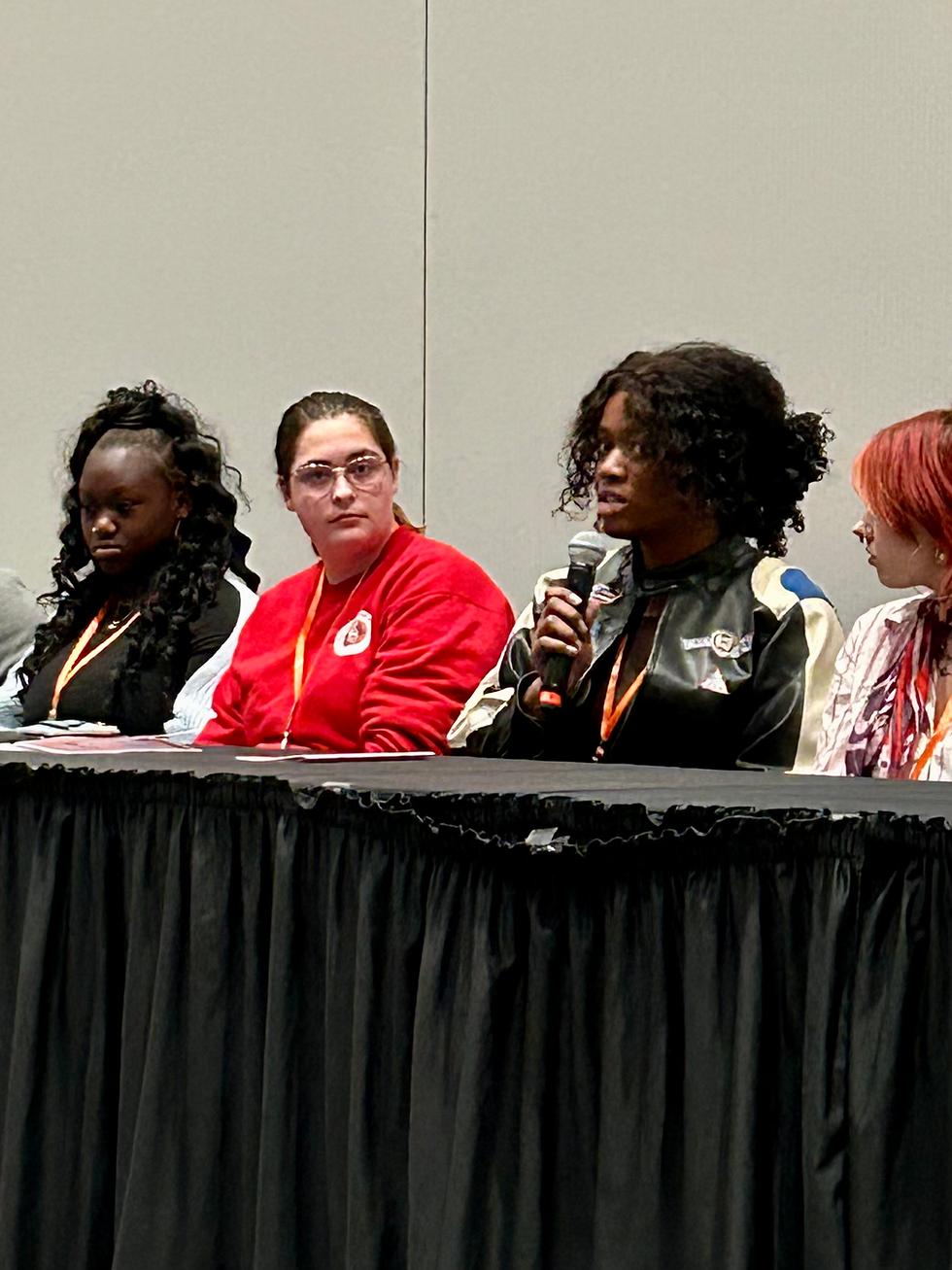
The 3rd Annual Emergency Gun Violence Summit in Milwaukee had over 600 attendees, ranging from elected leaders to high school students. Carthage School of Health students and a social work professor had the opportunity to attend, learn, and present at this event. This topic is important to the Social Work program because it demonstrates how working to prevent gun violence requires culturally responsive, interdisciplinary community-based approaches.
Read through student and faculty reflections below.
Katherine Pullam (2026) - Secondary Education Major
Although I am not from Wisconsin, nor a Social Work major, I didn't hesitate to sign up for the Milwaukee Gun Violence Summit.
It is a sad reality, but as a future educator, I felt the need to attend the Summit to protect my future classroom.
Gun violence is not normal, nor is it an unfortunate side effect of protecting the Second Amendment. It was reassuring to be present in a building where hundreds of social workers, lawyers, policymakers, and advocates shared my stance.
At the event, I learned that, statistically, a bipartisan majority of Wisconsinites support gun control reform. Admittedly, before attending this conference, I was under the impression that most who live in Wisconsin would have vehemently denied firearm reform. This was a good reminder for me to lead with questions, not assumptions, and to always keep an open mind.
This Summit inspired me, as a future educator, to provide my students with the skills to consider diverse perspectives on social issues, the tools to do their own research, the humility to acknowledge complexities, and the bravery to consider how they could address them.
Addison Oboyle (2029) - Allied Health Science Major
Before this Summit, I understood that gun violence was a serious issue, but hearing the voices of those directly impacted made it personal in a way that statistics never could.
Speakers discussed how gun violence deeply affects mental health — not just for victims and survivors, but for entire communities. Teachers, neighbors, and children all carry invisible scars from violence that happens around them. Hearing about the programs that offer counseling, healing circles, and youth mentorship gave me a sense of how prevention and recovery truly go hand in hand.
I learned that preventing gun violence isn’t only about laws, but it’s also about healing, connection, and compassion. It’s about giving people the tools and support they need to break cycles of pain before they turn into tragedy.
This Summit was a real-world extension of what I’ve learned in the classroom: that empathy and understanding are just as powerful as knowledge. Being there reminded me of Carthage's commitment to community, justice, and service. It challenged me to think critically about how I can use my education to promote change.
Though many of the stories shared were painful, something that especially stuck with me was hope. Hope came from seeing people who have experienced unimaginable loss stand up to make a change. Hope came from hearing young advocates talk about community healing and mental health support. Hope came from realizing that none of us are alone in wanting a safer future.
What gives me immense hope most of all is seeing people come together, people from different backgrounds, faiths, and experiences, united by the belief that every life matters, by belief in the power of education, empathy, and policy to make the world safer for everyone.
Because change doesn’t start somewhere distant; instead, it starts with us, right here, right now.
Leila Celeste (2029) - Student Veteran, Communications Major
The most moving part of the Milwaukee Gun Violence Summit for me was the diverse set of stories shared by youth explaining why this topic matters to them. Each story was unique yet equally passionate, and the open opportunity to share really personalized the experience for us all. Seeing a room filled with a large collective of community advocates and supporters, who all came together to fight for something they deemed important, was truly inspiring.
It reignited in me a hope and a confidence to take action, and I know it did the same for many others in the room.
As a U.S. service member, I know my peers are more susceptible to experiencing gun violence, suicide in particular. I want safety for my fellow soldiers. I want them to recognize their outlets when it feels like our work has taken over. To turn to each other and not to weapons when we feel afraid.
I’m especially thankful to the speakers and lawmakers in attendance who recognized this disparity and spoke up for veterans’ mental health. If even a single life is spared through the knowledge I gained at the Summit, it will have been a success for this indispensable cause.
Debbie Minsky-Kelly, LCSW, Field Director and Social Work Assistant Professor at Carthage College
I was excited to have the opportunity to bring twelve Carthage students to the 3rd Annual Emergency Gun Violence Summit in Milwaukee. This was my third year presenting at the Summit, and I anticipated many learning opportunities for students to better understand the health implications of gun violence, as well as potential policy solutions that could keep our communities safer.
What I didn’t expect, however, was that two of our students would courageously decide to share their stories of being directly impacted by gun violence as part of a youth panel on this topic. Listening to the stories of high school and college students directly impacted by this issue,
I was struck by the tendency for some young people to minimize their experiences.
Hearing statements like, “Well, it didn’t affect me directly,” followed by stories of a cousin, sibling, or best friend who had been killed, filled me with shock and sadness. Have we become so numb to gun violence in America that our youth feel their experiences aren’t valid?

In contrast, I experienced feelings of deep admiration and awe while listening to
other gun violence survivors. I heard from a survivor of the Oak Creek Sikh Temple shooting, Pardeep Kaleka, who lost his father in this horrific incident that was perpetrated by an affiliated white supremacist. Pardeep is a licensed therapist, and in the wake of his personal tragedy, Pardeep chose to work for peace and community prosperity by providing mental health care and began working with people involved in white supremacist groups. He talked about the importance of “meeting people where they are” and leading with compassion in these cases, recognizing these individuals as fully human and in pain.
I teach my students the social work ethical principle of respecting the dignity and worth of every person.
Witnessing this principle so fully embodied by Pardeep is an example that will resonate with my students and me for a long time.


Comments